


For medical review by the Sports Medicine, Foot & Ankle, and Hand/Wrist Teams at Lancaster Orthopedic Group.
Pickleball feels approachable because the court is smaller, the paddle is light, and the rallies can begin at almost any fitness level. But the sport still demands quick lateral movement, sudden stopping, reaching, twisting, and reacting to a ball while other players are close by.
That combination is especially important after age 50. Many players return to competition after years away from court sports, while others play more frequently than their muscles, tendons, balance, or recovery capacity are ready to support. The result can be an arthritis flare, an overuse problem, or a sudden injury during one awkward step or fall.

Why Pickleball Injuries Increase With Age
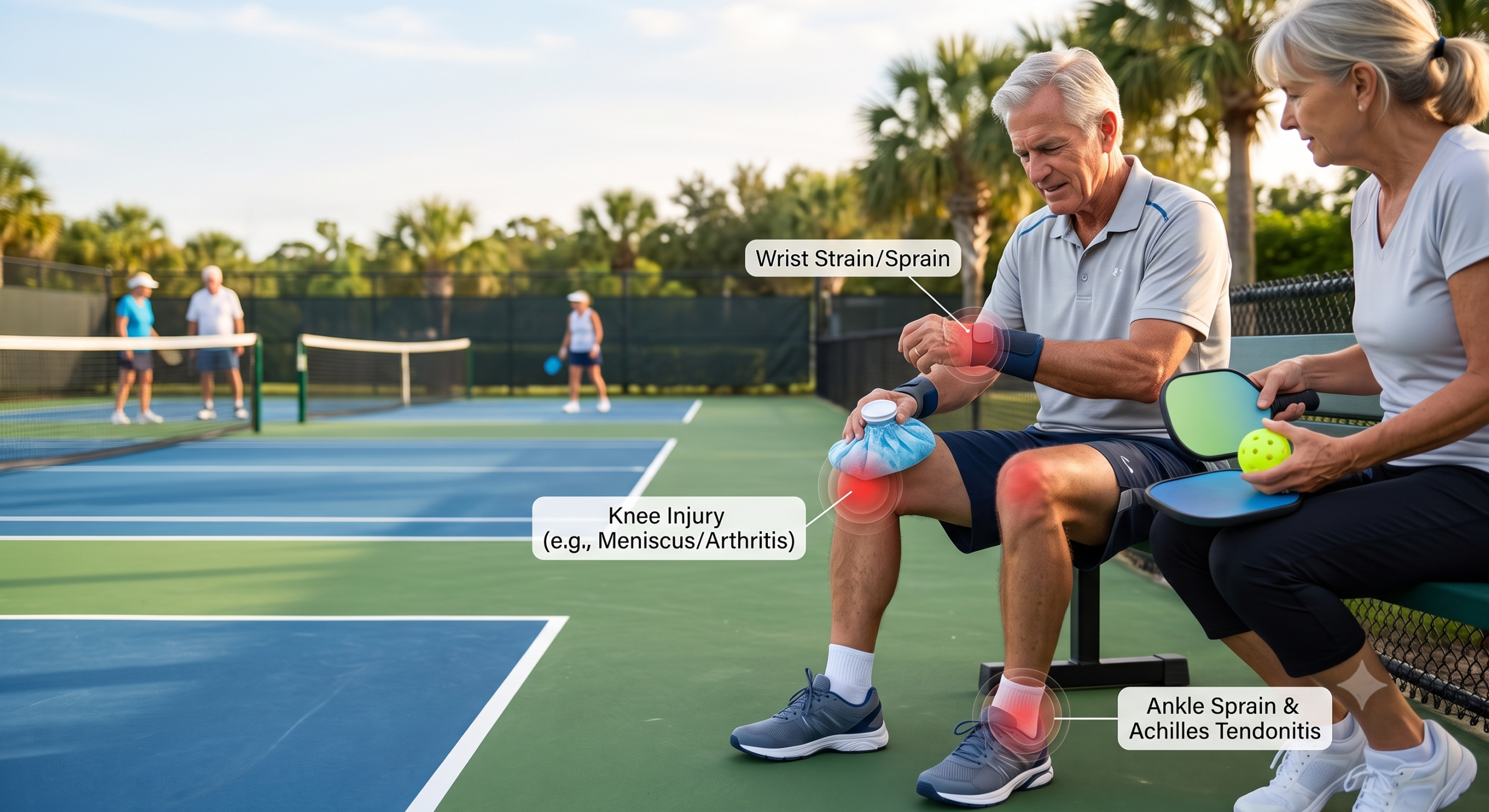
National emergency department research has found that older adults account for most pickleball injuries requiring hospital-level evaluation. Falls are a major mechanism, and older players are more likely to sustain fractures and wrist or hand injuries. Age itself is not the problem. The risk comes from the gap between what the game demands and what the body has recently practiced. Prior arthritis, reduced ankle mobility, loss of muscle power, changes in balance or vision, osteoporosis, old injuries, and fatigue can make a late reach or backward step harder to recover from.- Rapid side-to-side movement stresses knees and ankles.
- Short sprints and sudden push-off load the calf and Achilles tendon.
- Reaching for a low ball can place the body outside its stable base.
- A fall onto an outstretched hand transfers force into the wrist, elbow, and shoulder.
- Long sessions and back-to-back playing days reduce recovery time.
1. Knee Pain and Knee Injuries
The knees absorb repeated stopping, pivoting, lunging, and direction changes. A player with osteoarthritis may notice swelling, stiffness, or aching after play. Sudden twisting can irritate a meniscus, while a forceful change of direction may injure a ligament or strain the muscles and tendons around the knee.Signs of an arthritis flare
A flare usually causes familiar aching, stiffness, swelling, and reduced tolerance for stairs or prolonged activity. The knee may feel worse later in the day or the morning after playing, but it should gradually settle with an appropriate recovery plan.Signs of a more acute injury
A pop, immediate swelling, instability, locking, or inability to bear weight suggests more than routine soreness. Continuing to play can make the knee less stable and increase the risk of a fall.2. Ankle Sprains
An ankle sprain often occurs when the foot lands on its outer edge during a lateral step, when a player crosses their feet, or when momentum carries the body beyond the planted foot. Pain and swelling are usually concentrated around the outside of the ankle, although more serious sprains can involve other structures. A mild sprain may allow walking with a limp. Severe swelling, tenderness directly over a bone, deformity, numbness, or inability to take several steps should prompt evaluation for a fracture or higher-grade injury.3. Achilles Tendon Pain and Rupture
The Achilles tendon connects the calf muscles to the heel and powers push-off. Pickleball repeatedly asks it to accelerate the body from a low or nearly stationary position. A tendon that has not adapted to that load may become painful over time or tear during one sudden movement.Achilles tendinopathy
Achilles tendinitis usually develops gradually. The tendon may feel stiff when first getting out of bed, sore at the start of play, somewhat better after warming up, and painful again later. Thickening or persistent tenderness a few centimeters above the heel is common.Achilles rupture
A rupture is sudden. Players often describe a pop or the sensation that someone kicked the back of the leg. Walking becomes difficult, push-off feels weak, and standing on the toes of the injured leg may be impossible. This injury requires prompt assessment.4. Wrist, Hand, Elbow, and Shoulder Injuries
The most consequential upper-extremity injuries often occur during a fall. Landing on an outstretched hand can cause a wrist sprain or fracture, and the force may travel into the elbow or shoulder. Older adults with lower bone density may fracture the wrist after a fall that would have caused only a sprain earlier in life. Overuse problems also occur. Gripping the paddle tightly and repeating backhand or wrist-heavy strokes can irritate forearm tendons. Shoulder pain may develop when players reach repeatedly or use poor mechanics for overhead shots.- Visible deformity, rapid swelling, or severe tenderness after a fall needs prompt evaluation.
- Numbness, tingling, pale fingers, or an inability to move the hand normally should not be ignored.
- Persistent elbow or shoulder pain that changes your swing deserves attention before compensation creates another problem.
5. Falls: The Injury Behind Several Other Injuries
Pickleball falls commonly happen while backpedaling for a lob, reaching across the body, stepping on another player’s foot, or trying to change direction after momentum has already shifted. The fall may injure the wrist, shoulder, hip, knee, or head. A head impact, loss of consciousness, confusion, repeated vomiting, worsening headache, new balance difficulty, or unusual sleepiness requires urgent medical assessment. Lancaster Orthopedic Urgent Care treats new bone, joint, muscle, and sports injuries, but it is not an emergency department and does not treat head injuries or other medical emergencies.The Difference Between Soreness and Injury
Expected post-play soreness
General muscle soreness often appears later, affects both sides, and improves over a day or two. It should not create major swelling, instability, sharp focal pain, or loss of normal function.A possible overuse injury
Pain begins earlier in each session, lasts longer afterward, or changes how you move. The area may be consistently tender, and performance declines even though you are trying to warm up.A possible acute injury
There is a specific twist, pop, fall, or impact followed by immediate pain, swelling, weakness, deformity, or inability to continue. That pattern warrants a lower threshold for evaluation.Seven Ways to Reduce Pickleball Injury Risk After 50
1. Build court time gradually
Start with shorter sessions and recovery days rather than jumping directly into multiple leagues or tournament-length play. Increase either frequency, duration, or intensity at one time instead of all three together.2. Warm up for the movements the game requires
Spend several minutes walking briskly, moving side to side, performing controlled calf raises and sit-to-stands, and practicing easy swings before competitive rallies. Static stretching alone does not prepare the body for acceleration and change of direction.3. Strengthen the calves, hips, thighs, and trunk
Calf raises, squats or sit-to-stands, step-ups, side steps, and hip-strengthening exercises build the force and control needed to stop and redirect. A physical therapist or clinician can modify exercises around arthritis or prior injury.4. Train balance, not just strength
Single-leg balance near a stable support, tandem walking, and controlled reaching can improve the ability to recover when the body drifts outside its base. Balance work should be challenging without creating a fall risk.5. Use shoes made for lateral court movement
Court shoes are designed to support side-to-side movement. Replace worn shoes, keep laces secure, and avoid playing on wet, cracked, or cluttered surfaces. More cushioning is not automatically more stability.6. Stop backpedaling for lobs
Backpedaling is one of the easiest ways to lose balance. When possible, turn the body and move more deliberately, communicate with your partner, and let an unreachable ball go rather than converting one point into an injury.7. Respect pain that changes your mechanics
If you begin limping, protecting one side, or changing the swing to avoid pain, the session is no longer building fitness. It is rehearsing compensation. Stop, recover, and evaluate persistent symptoms.When to Seek Orthopedic Care
- You cannot bear weight or use the injured arm normally.
- There is deformity, rapid swelling, extensive bruising, or focal bone tenderness.
- The knee locks, gives way, or swells soon after a twist or pop.
- The Achilles tendon pops or push-off becomes suddenly weak.
- Pain repeatedly returns, starts earlier during play, or lasts longer after each session.
- Numbness, tingling, coolness, or color change develops beyond the injury.
What an Orthopedic Evaluation May Include
The clinician will ask how the injury happened, whether there was a pop or fall, when swelling began, and what movements are now difficult. The examination may assess stability, strength, tendon integrity, range of motion, balance, and tenderness. X-rays can identify fractures and arthritis. Ultrasound or MRI may be considered for tendon, ligament, meniscus, or other soft-tissue concerns when the result will change treatment. Many injuries improve with bracing, rehabilitation, activity modification, or medication, while ruptures, unstable injuries, and some fractures require surgical discussion.Returning to Pickleball Safely
Return should be based on function rather than the calendar alone. Before competitive play, you should generally be able to walk briskly, change direction, balance, perform repeated calf raises or controlled sit-to-stands, and swing the paddle without sharp pain or significant compensation. Begin with drills or a short recreational session. Stop if pain escalates, swelling returns, or mechanics deteriorate. A gradual return may feel conservative, but it is faster than turning a manageable injury into a prolonged one.Planning Pickleball Injury Care in Lancaster County
Lancaster Orthopedic Group provides sports medicine, knee, foot and ankle, wrist and hand, imaging, and physical therapy services for active adults. Orthopedic Urgent Care at Granite Run and the Same-Day Clinic in Ephrata are designed for new acute bone, joint, muscle, and sports injuries; chronic or recurring problems are better scheduled with the appropriate specialist. The goal is not to talk people over 50 out of pickleball. It is to keep the game sustainable by matching court demands with strength, balance, technique, recovery, and timely care.Frequently Asked Questions
Is pickleball safer than tennis after 50?
The smaller court and lower serving demands may make pickleball easier to start, but the sport still involves falls, pivots, lunges, and sudden acceleration. Individual conditioning, prior injuries, playing volume, and movement choices matter more than the label.Should I wear an ankle or knee brace?
A brace may help certain patients with previous instability or arthritis, but it is not a substitute for strength and balance. The correct brace depends on the diagnosis and should not create numbness, swelling, or restricted circulation.Can I play with knee arthritis?
Many people can continue with modified volume, appropriate footwear, strength work, recovery, and treatment of symptoms. Persistent swelling, instability, loss of motion, or pain that changes how you move should be evaluated.How do I protect my Achilles tendon?
Increase playing volume gradually, strengthen the calf through a comfortable range, warm up before explosive movement, and address recurring stiffness or tenderness early. No warm-up can eliminate rupture risk, especially when the tendon is already symptomatic.Where should I go after a pickleball fall?
A new possible sprain, strain, closed fracture, or joint injury may be appropriate for orthopedic urgent care. Head injury symptoms, chest pain, uncontrolled bleeding, an open wound over a fracture, or another medical emergency requires an emergency department.Wrapping Up
Pickleball can be an excellent way to stay active after 50, but the body still needs preparation for lateral movement, sudden push-off, and falls. Knees and ankles absorb the direction changes, the Achilles powers acceleration, and the wrist often takes the force when balance is lost. Build capacity gradually, train strength and balance, use stable court footwear, avoid unnecessary backpedaling, and respond early when pain changes your mechanics. The objective is not merely to finish today’s game. It is to be ready for the next season. Call 717-560-4200 or request an appointment online to get started.Have questions as you prepare for your joint replacement surgery? Call our office

Speak to a Specialist
717.560.4200